|
[ Home ] [ Leadership ]
[ About Bill ]
[ News ]

|
Bill Rowell
- Franklin County
Vermont -
Agriculture
relies on leadership capable of recognizing our
needs, bringing the system to focus on today's challenges and
delivering responsible timely solutions. |
Green Mountain Dairy
Vermont's Dairy Farm of the Year
2008
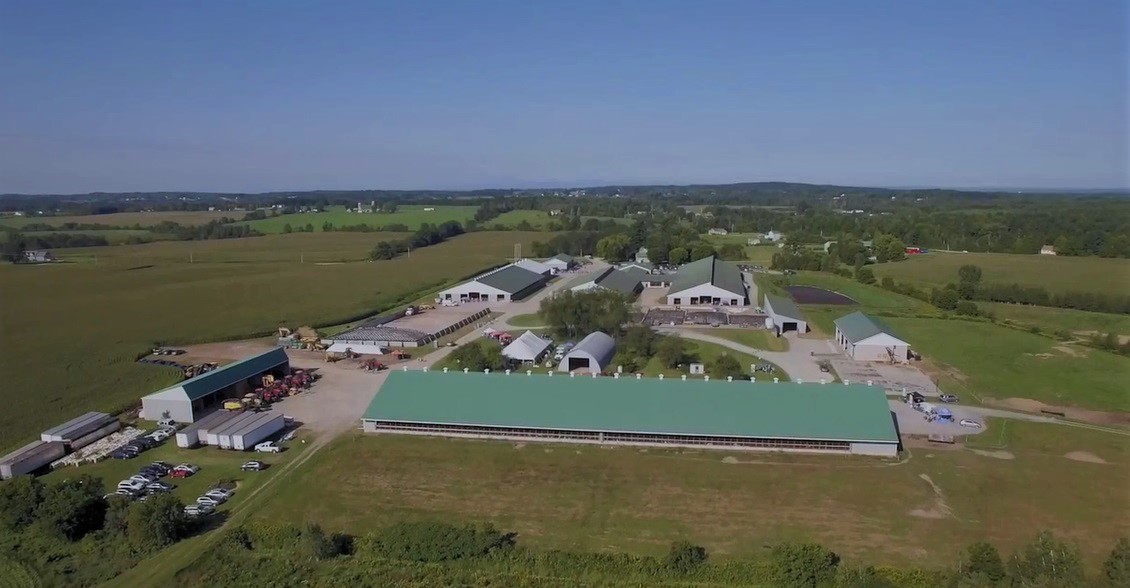
Green Mountain Dairy of Sheldon is a large farm operating under a LFO
permit administered by the Vermont Agency of Agriculture.
The dairy currently has 900 lactating Holsteins and 150
dry cows on site. Three state of the art barns, built in 1999,
house the milking herd. A heifer barn was completed during 2008
to accommodate 500 heifers and calves ranging in age from 90 days to 22 months.
Our
cows are milked 3 times each day, and produce award winning
milk, year after year, for the St Albans Co operative Creamery,
which supplies the Boston fluid milk market, Ben & Jerry's Ice
Cream, Stonyfield Yogurt, as well as several cheese makers.
There are 25 full time
employees on payroll.
Cropland
consists of approximately 1500 tillable acres in four towns, Sheldon,
Highgate, Swanton and St. Albans. The farthest fields are 7-8
miles from the dairy. The farm harvests 900 acres of corn and
600 acres of hay. Nutrient management plans are developed in
accordance with NRCS Nutrient Management Conservation Standards. Manure management plans are developed under accepted agricultural practices criteria in conjunction with
a best management practices program, administered by the
Vermont Agency of Agriculture to satisfy requirements of the LFO
permit.
Green Mountain
Dairy is a large scale farming operation, resulting waste
amounts to a large volume of cow manure daily.
Increased environmental awareness and regulatory attention to
manure disposal tend to focus on contaminants leaching to
underground aquifers, contaminant runoff to surface waters,
nutrient loading of soils, release of greenhouse gases (GHG) in
to the atmosphere, and odor.
Anaerobic
digestion is a method of utilizing unprocessed cow manure as a
renewable resource, which recognizes our responsibility to the
environment. The digester process, completed in 21 days, greatly
reduces pathogens, fly and insect larvae, weed seeds, and odor.
The remaining bio solids are pumped from the effluent pit at the
end of the vessel to a manure solids separator. Separated
solids, which have little odor and look a good deal like peat
moss, are used as bedding for the herd. The herd requires less of
this material than is available, the balance is sold to after markets such as
nurseries or composters as soil amendment material.
The separated liquid flows into the dairy's
storage lagoon. A large advantage of the liquid from the
treatment process is reduced odor during field spreading. On
open ground, such as those fields being prepared for planting,
Manure is injected into the soil which further reduces odor as
well as the potential for runoff.
The process of
an on farm anaerobic digester system is to collect raw manure
into a receiving tank or vessel. During the first stage, the
manure is mixed and heated to 101 degrees Fahrenheit in a vessel
creating volatile fatty acids. The second stage grows
methanogenic bacteria, which convert volatile fatty acids into
biogas, primarily methane and carbon dioxide. The methane biogas
is collected from the vessel and used to fuel a combined heat
and power generator set. CHP gensets are commercially available
reciprocating engines designed to burn biogas.
On a continuous basis of operation, the volume of manure at
Green Mountain Dairy produces enough biogas to consistently
generate a minimum of 300 kWh per hour of electricity. No
seasonal variations are experienced in the system. The anaerobic
digester and resulting electricity, classed as renewable energy
or green power, provides multiple benefits to the environment,
our farm and society. During the past 12 months of operation, we
have produced 1,800,000 kWh of electricity to the grid, enough to
power 300 average sized homes. Additionally, the farm has hosted
tours for more than 33,000 people from 48 countries, part of an
outreach project to share our insight with those interested in
today's farm.
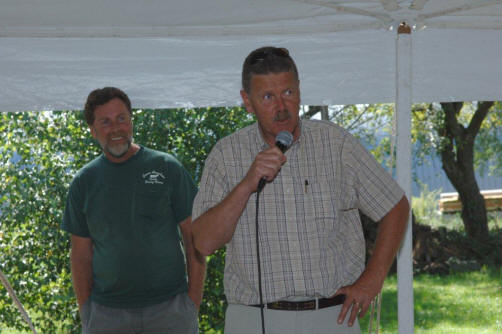
Green Mountain Dairy Open
House - May 2007
Brian & Bill Rowell
addressing the audience, over 1000 attended
|